


I get an awful lot of satisfaction from winding yarn I’ve spun neatly, even when it makes no logical sense. This ball took me over an hour to place every strand carefully, when I could have quickly and easily wound it on my ball winder in 5 minutes. It’s completely irrational! It clearly scratches a part of my brain that finds winding a neat ball slowly and precisely, and seeing the colour patterns changing, very relaxing.
(Ad) Almost all of the yarns in this blog post were spun on Electric Eel Wheel e-spinners - This is an affiliate link. If you click through any of the product links and make a purchase, I may receive a small percentage of the purchase price at no additional cost to you. Any income from my blog goes a small way toward funding future blog projects.
 |
| Bamboo single spun on the Electric Eel Wheel 6 |
It’s no secret that if you move the yarn guides frequently, in tiny increments, you’ll get more yarn on the bobbin than if you let it build up in little hills. As well as getting fuller, neater-looking bobbins, you may also notice that the brake tension is more consistent, as the diameter of the yarn on the bobbin tube isn’t varying very much.

It also pulls off the bobbin more smoothly for plying if you move the yarn guides more frequently.

This yarn was pre-chain-plied with chains that were over 11 metres long to encourage barber poling. It was imperative that the yarn wound off the bobbin smoothly, as the singles spanned the full length of my house.

The mounds of yarn are far less likely to topple over (which means you have to pull on them a little more to release the singles) if you don’t allow them to build up too much. It’s also very difficult to lose your yarn end if you wind the bobbin neatly.
It’s not good for my body to sit in the same position for hours on end, so stopping regularly and taking little micro breaks reduces the health risks associated with sitting in the same position for too long.
All of these reasons are how I justify to myself my slightly bonkers obsession with winding a neat bobbin…
The App that helps me fill a bobbin more neatly

I have a chronic spinal condition, so I originally began using the Seconds app to help me time my daily physio stretch intervals. When I began using e-spinners, I quickly realised that I could also use the Seconds App to prompt me to move the yarn guide.
(Not Sponsored) I use the Apple App Store version of the Seconds App on my iPhone, iPad, and Apple Watch in various settings and scenarios, but it's also available on the Google Play App Store.
My preferred spinning position is sitting slightly reclined, and drafting sideways with the e-spinner sitting to the right of me, perpendicular to my knee. I find drafting by slowly moving my hands sideways, apart and together, doesn’t irritate my neck and shoulders in the way drafting forwards or backwards can. Unfortunately, this does mean that the wheel isn’t in my eye-line, and, as turning my neck is painful, I’ve had to find a workaround to remind me to move the yarn guides when I can’t easily see the mound of yarn building up on my bobbin.
The Seconds interval timer has been a game-changer for me as it means I can zone out, sit back, and relax into the spin. When I see the app change colour, hear it beep, or feel it buzz on my watch, I know it’s time to move the yarn guide without having to constantly monitor my bobbin.

I began occasionally using the Seconds App while spinning on my Electric Eel Wheel 5 as a reminder to move the yarn guide when it wasn’t in my field of vision, but when I purchased the Electric Eel Wheel Nano it became my permanent spinning companion.
The official maximum capacity of a Nano bobbin is about 50g. This is an approximate figure, and the capacity can change depending on yarn gauge, fibre content, texture, drafting style, tension, whether it's a single or plied yarn… and how frequently you move the yarn guides.

Here’s a photo illustrating how much more you can get on a bobbin if you move the yarn guide more frequently. Both of these bobbins have exactly 46g of singles on. The fibre is identical, as is the wpi, angle of twist, and the tension used while spinning. The only difference is that I moved the yarn guide every 2.5 minutes for the one on the left, while I moved the yarn guide every 60 seconds for the one on the right.
Moving the yarn guide every 60 seconds rather than every 10 minutes can mean being able to add an extra 20% on the bobbin, and on a Nano bobbin, every extra gram makes a difference.

As an aside, I made this graphic when I was testing the capacity of the Electric Eel Wheel Fold. The yarn on the right is exactly the same weight and fibre type as the one on the left. The difference is that it has been chain-plied, so it is thicker, airier, and more textured, so it now takes up a lot more space on the bobbin.
The technique for getting smooth bobbins
Most instructions for sliding yarn guides encourage you to let a little hill of yarn build up and then move the yarn guide a cm or so onto the lower level of yarn on the bobbin so that you end up with lots of little hills and valleys along the length of your bobbin. This very much replicates the undulating bobbins you naturally get from a spinning wheel with hooks along the length of the flyer, and there is absolutely nothing wrong with this approach - as long as you don’t allow the hills to build up so much that they topple over and trap the singles.

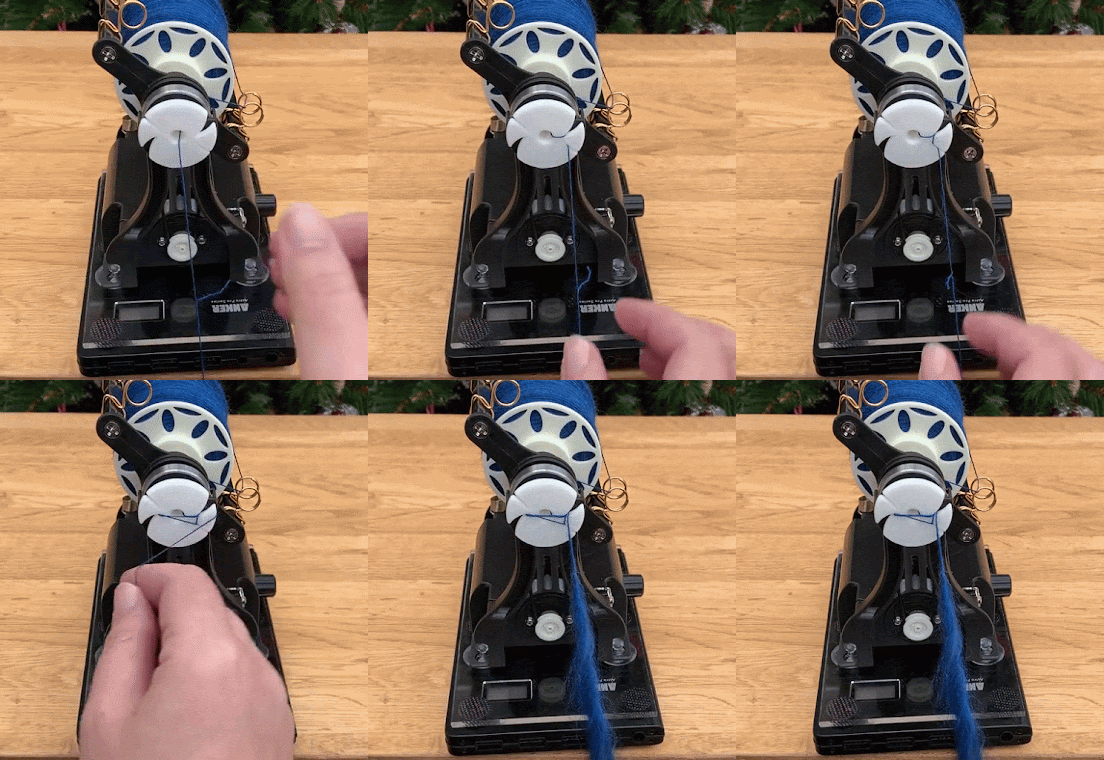
Hopefully, in this animated gif, you can see that I don’t move the yarn guide into a lower area (I took a photograph every time I moved the yarn guide). Instead, I move it just a few millimetres along so that the yarn falls on the side of the little mound of yarn I've just spun. By doing this all the way along, I get smooth bobbins rather than undulating ones.
This was quite an extreme example, as I was intentionally moving the yarn guide every 60 seconds to make a stop-motion video. I find that if I allow the singles to build up a lot more, over 3 or 4 minutes, I still get relatively smooth, neat bobbins by moving the yarn guide to the mid-point of the side of the little hill of yarn. Pleasingly, the smoothness of the bobbin becomes more pronounced the fuller the bobbin gets as the circumference of the yarn on the bobbin increases.
This YouTube Short shows the movement of the yarn guides in more detail.
Only moving the yarn guide in one direction
When my yarn guide reaches the front, I take it all the way to the back of the bobbin again in one sweeping motion. This serves a few purposes. It makes it easier to find the yarn end as the final layer gradually covers the single strand spanning the bobbin. It means that I’m only moving the yarn guide towards me, so it’s easier to see and easier to move, and it also means that I’m not building up a double-height layer when I get to the end. The single layer at the bobbin end means that it will pull off my lazy Kate more easily and give me prettier colour-changing bobbin ends if I’m spinning a multicoloured yarn.

Programming the Seconds App
In this video, I walk you through the steps for programming the Seconds App to be an interval timer. To save editing time, I don't speak on the video, but for clarity, the steps are as follows -
- Click on the plus symbol.
- Select Circuit/Tabata Timer.
- Name the timer - mine is going to be a 1-minute timer.
- Click on Exercise 1.
- Rename 'Exercise 1' to be the instruction you want displayed. Mine is just 'Move Yarn Guide'.
- Change the duration to whatever you want the interval to be.
- Click back and add another Exercise.
- Repeat to rename Exercise 2 and add a duration, but this time change the colour to a contrasting colour.
- Click back and select Alerts.
- Decide on the sound you want the app to make at the end of the interval.
- Click back and type in the number of sets or repeats you would like. I have two sets totalling two minutes, so if I change the set number to 200, this will give me a total spinning time of 6 hours and 40 minutes, which is plenty!
Filling a neater Nano 2.1 bobbin

When I was beta testing the Electric Eel Wheel 2.1, I highlighted an idiosyncrasy that means if you use the yarn guides as originally intended, the bobbin doesn’t fill quite so neatly and efficiently.

As you can see, moving the yarn guide the conventional way doesn’t fill the very front of the bobbin. It will fill up eventually as the circumference increases, and the edge starts to compress and topple a little bit, but those very end singles will always be looser and less compact.
Well, the Nano 2.1 has been available for quite a few months now, and I am yet to see another spinner bemoaning the fact that they can’t get neat bobbin ends on the 2.1, so I’m clearly quite bonkers and alone in my obsession …
However, it bothers me, especially as the Nano 2.1 bobbin ends are so beautifully open, and the capacity is only about 50g.
When designing the 2.1, Maurice Ribble, quite rightly, prioritised improved yarn guides and overall bobbin capacity over more efficient bobbin filling.
When I shared my issue with not being able to wind singles onto the very front of the bobbin, Vampy pointed out that if I moved the single onto the first yarn guide, the bobbin front would be a lot neater. Sometimes, I can’t see the wood for the trees!

Well, after filling one bobbin, I decided that swapping the single back and forth in that small space at the front of the bobbin was a little fiddly and obsessive - even for me. (I lost control of the single a couple of times and it ended up winding around the flyer in front of the bobbin…) I eventually worked out a technique that felt a lot less problematic and more user-friendly.
In this YouTube Short you can see that once the rear yarn guide reaches the front, I slide it all the way to the back again with the yarn still in position. This makes it easier to remove the single and place it on the front yarn guide. I then carry on filling the front of the bobbin using the front yarn guide. Once the front is level with the rest of the bobbin, I loop the single around the rear yarn guide and start all over again, sliding the rear yarn guide from the back to the front, filling the bobbin in tiny increments.

My Dream e-spinner (that doesn’t exist!)
There was a time when I would have loved a WooLee Winder or an Autowinder. Before I started using an interval timer to remind me to move the yarn guide, the idea of not having to keep turning my neck to monitor my bobbins was very alluring. The notion that I could just zone out and spin, spin, spin - especially for plying - was so very tempting, but way out of my price range.
I regularly read that you can fit more yarn on a bobbin with a level winding flyer, but I have to disagree. WooLee Winders or Autowinders wrap the yarn diagonally, so it's reasonable to infer that you would fit less yarn on a bobbin with a level winding flyer than if you were to move the yarn guides using my preferred method. When the singles are criss-crossing their way along the bobbin, lots of tiny air pockets are incorporated with every layer, so it follows that a bobbin would fill more densely if the singles are not allowed to build up and are all laid almost parallel to each other.
My ideal level winder would be one that remained stationary for a minute or so and then moved on a few mm to fill the next small section of the bobbin. What if the stopping times and travelling distances were programmable to account for spinning speed and yarn thickness? How cool would that be?
For me, the next best thing would be a programmable “Beautiful Bobbin Mode”. I mentioned my idea for a “programmable, slow-stopping interval system” at the end of my review of the Daedalus Sparrow.
- What if you could program spinning intervals into the e-spinner that would automatically stop the wheel slowly after a set amount of time? You would then adjust the yarn guides by hand, allowing you to check your progress, stretch a little, before resuming spinning again for the next interval of time. I find it much more relaxing to zone out and spin when I’m not constantly turning my neck to check how full the bobbin is, and I wonder if a perfectly able-bodied person would also welcome the idea of not having to constantly monitor their bobbins.
It might not be ideal for high-speed long draw, but I can see it being helpful for plying or for a more sedate worsted spinner, like myself.
Ah, a girl can dream…

If you've found any of this post interesting or useful, please pin this image to Pinterest. It makes a big difference to me and helps other spinners find it too.
At this point, I normally suggest similar related blog posts; however, my list of spinning-related content is becoming a little unmanageable... If you'd like to read more blog posts about spinning and fibre preparation, please take a look at this page here, where you will find links to all of my spinning and fibre articles.
Thank you for reading, and happy spinning!
----------
Related Posts
 |
| The Evolution of the Electric Eel Wheel |
 |
| Electric Eel Wheel Nano Orifice Reducer with a built-in Twist Keeper and Other Modifications |


 |
| Free Handspun Yarn Labels |
 |
| DIY Hackle - My £22 Onion Slicer Hackle |
 |
| DIY Mini Wool Combs |
 |
| Spinning Dog Hair |
Please be sweet and share the love. Leave a comment, like my Facebook page for regular updates or follow me on Pinterest or Instagram


6 comments:
Fantastic post! This makes my brain so happy and I can't wait to hyperfocus on level bobbins lol. I also LOVE your idea of a programmable auto-winder. I really hope Maurice adds this to the "professional EEW" and that it happens soon.
Thanks so much Kathryn, this is a gamechanger! And so useful to see a full bobbin, I thought I may just let the 6.1 go when the Fold arrives, but it looks like for 100g of plied yarn nowhere nearly arranged on the bobbin as neatly as yours the 6 still has an edge!
i think i’m missing something - if you are not turning your head , how are you able to move the guides every minute
I didn’t say I don’t turn my head to move the yarn guide, just that turning my head to look at the e-spinner when it’s not in my eye-line is painful.
The e-spinner is in front and to the right of my knee. I don’t look at it at all while I’m spinning (I’m usually zoned out watching TV or a film). I will move my eyes and turn my head briefly when I stop to move the yarn guide, but the interval timer means I’m not constantly turning my head to monitor my bobbin.
Yes, the Fold’s a nice size for 100g braids, but the 6.1 wins when it comes to plying 2 x 100g braids together.
I have never seen anyone in the spinning community dig into this topic as well as you have. I own a Hansen minispinner and plan to take off my Woolee Winder for the next spin just so I can try this method myself. I’ve always made small hills and filled valleys. I’ve never tried just moving the guides towards me!! Looking forward to the experience!
Post a Comment